
 By
By 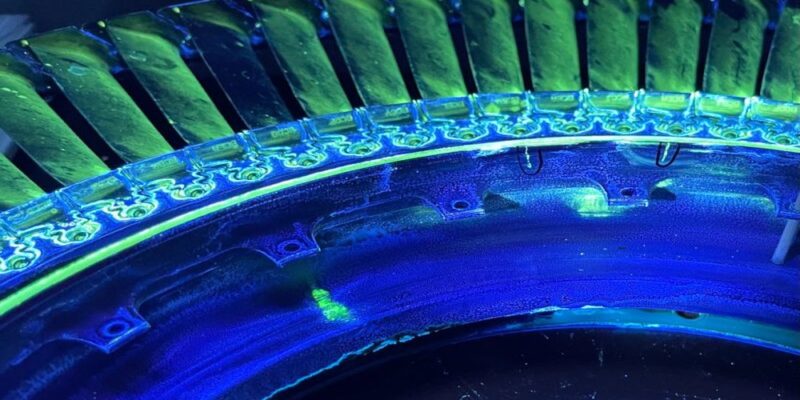
Fluorescent penetrant inspection, or FPI, is an NDT or non-destructive testing technique. It uses black light and a dye-penetrating agent.
This is used by engineers and technicians in key industrial sectors. So, they can find surface defects in materials such as metals and plastics. Therefore, dye penetrant testing experts are required.
Surface fractures can eventually lead to part failure and possibly catastrophic damage if they go unnoticed. This is the reason the assessment is so crucial.
What is the process of fluorescent penetrant inspection?
Although they are all synonymous, FPI can also be referred to as liquid or dye penetrant inspection. Two kinds of these solutions are frequently used – visible and fluorescent. The procedure is the same irrespective of the liquid used:
- Clean the Surface: Before testing starts, the surface needs to be cleared of any debris or dirt. Wire brushing, grinding, or solvent degreasing can be used to do this.
- Apply Infiltration: Ones that glow under UV-A black light are applied to the surface of the substance being tested. To get into any openings, the infiltration must be applied using a brush or spray gun. It’s left on its outer layer for up to half an hour.
- Remove Extra Infiltration: Carefully remove extra infiltration from the surface using a fresh cloth or a water rinse. Naturally, great care is taken in this situation to prevent the agent from being removed from apertures.
- Apply the Developer: A developer is applied after the agent has seeped into any cracks or gaps. Read from https://www.nde-ed.org/NDETechniques/PenetrantTest/QualityProcess/DeveloperQC.xhtml for added info.
- Examine the Region for Signs: When the developer pulls through the penetration. The damage becomes apparent to the unaided eye. Depending on the degree of sensitivity level. The indicator can be weak; the engineer or technician carefully examines it.
Usual Applications
This testing is utilized in a number of industries where safety-critical components are found. Regular assessments are crucial for identifying problems early and guaranteeing safe operations. Below is a list of some typical uses.
The aviation industry
These are used by the aerospace industry to find flaws in engine and aircraft parts. Especially during maintenance and repair procedures.
Automobile
This testing is mostly used in the automotive industry for production equipment maintenance and nonferrous part design.
Energy
A liquid probe is crucial for the examination of welds, valves, vanes, and blades. Especially in the energy industry’s gas and oil, nuclear, gas turbine, and wind sectors.
Shipping & Marine
Ship makers are required by classification bodies to conduct NDIs on newly constructed, rebuilt, and repaired vessels. Therefore, the infiltration test is widely employed in the maritime and marine industries. For example, while inspecting pipes, propellers, and ship weldments.
Importance
An NDT technique that doesn’t damage the components being examined is liquid probe inspection. The techniques identify surface-level defects. Such as cracks, fractures, laps, seams, and others.

These may have been brought on by stress, impact, quenching, fatigue, grinding, machining, or forging. The procedure is applied to castings, forgings, machined pieces, and other objects. Since they need repair or are about to be put into service.
The procedure entails immediately putting a visible or fluorescent infiltration chemical on the component. After removing the extra probe, a developer is used to pull it deep into the cracks and onto the part’s surface.
This break is easier to find since the infiltration clashes with the component. When they are exposed to UV light, they fluoresce. The principles and advantages of FPI have stood the test of time. Despite the expansion of chemical, equipment, and NDT accessory options.
Applications And Uses Of Versatile Materials
The majority of materials – additional info – that are not very rough or porous can be inspected. This is achieved by using a liquid probe, regardless of its composition. It could be magnetic/nonmagnetic, metallic/nonmetallic, and conductive/nonconductive.
Examine vast areas and lots of parts quickly.
A quick, simple, and effective method of inspection. It is possible to swiftly inspect large numbers of materials or pieces. It is possible to examine parts of nearly any size, shape, or geometry.
Determine minute irregularities with great acuity.
Sensitivity degrees are a classification scheme used only for fluorescent liquid probes. They are not used for visual penetrants. Smaller fractures and flaws can be found by probes with higher sensitivity.
Justifications for Various Sensitivity Levels
Sensitivity as well as background fluorescence must be balanced in fluorescent NDT.
Smaller fractures and flaws can be found by probes with higher sensitivity. On the other hand, this will be brighter for those with higher acuity.
The inspection may be hampered by excessive background fluorescence. This makes it challenging to spot infiltration signs. Indicators may blend in with an overly fluorescent background rather than stand out for simpler scrutiny.
Although they have less background than higher sensitivity probes. Lower sensitivity penetrants are unable to pick up on subtle clues.
To enhance indication detection. It is crucial to utilize a high enough level of acuity to find the required indications. While minimizing the fluorescent background.











Comments